
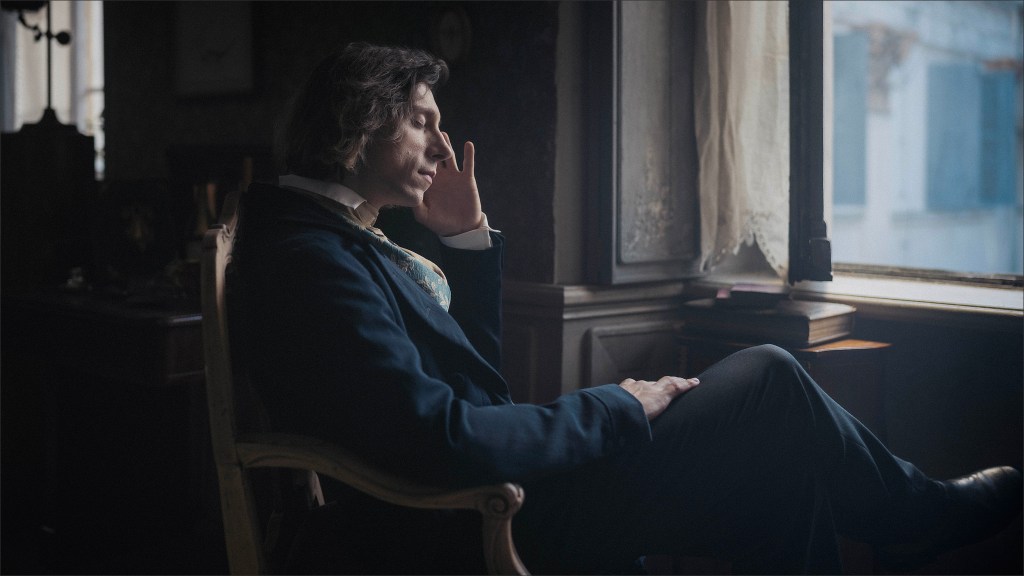

At the window of a modest Parisian apartment, we are introduced to the figure of a calm, reflective man contemplating life as though he possessed all the time in the world. Around him, an incessant and irritating fly disturbs the peaceful atmosphere of that afternoon.
The fly that repeatedly appears around Chopin — both in this scene and in several that follow — works as a subtle omen of death, transforming tuberculosis not merely into a physical condition, but into a lingering presence that contaminates even moments of pleasure and social recognition.
First Movements
Directed by Michał Kwieciński, Chopin, Chopin! follows the Polish composer’s life during his years in the French capital. Between aristocratic salons, private performances, and lavish gatherings among the Parisian elite, Chopin’s concerts quickly become object of luxury, not only because of his undeniable technical brilliance, but mainly due to his cheerful, charismatic, and charming presence.
Approaching the subject differently from previous biopics, Kwieciński’s version introduces us to the artist behind the social mask — someone who uses music both as a refuge and as a way to process emotion. And despite the constant reminder that Chopin is a doomed man, it becomes surprisingly easy to fall for his carefully constructed role of the charming genius, much like the Parisian aristocracy surrounding him did.
A large part of that comes from Eryk Kulm’s exceptional performance, bringing this young man — alive in every possible sense of the word — to the screen, even in his moments of deepest suffering.
However, as the symptoms of tuberculosis become increasingly visible — reinforcing the prognosis established by doctors since the very beginning — the narrative gradually abandons any romanticized notion of the tortured artist archetype in favor of a more human, contradictory, and, dare I say, even staged, version of Chopin.
Dissonances
Reflecting the pianist’s inner contradictions, the soundtrack occasionally pulled me out of the experience. I’m not entirely sure what the intention behind this choice was, but the synthesizers and the overall style often felt strangely disconnected from the film’s atmosphere. Whenever the soundtrack returned, it almost felt as if Chopin were drifting between dimensions — I could only think of the Upside Down from Stranger Things.
So, if we choose to interpret Chopin as someone profoundly disconnected from the emotional and social expectations surrounding him, then perhaps the soundtrack was intentionally designed to create this very sense of contrast and displacement.
Nothing is ever directly verbalized, yet Chopin is portrayed as someone incapable of connecting emotionally in the way others expect him to. His discomfort around romantic relationships and the constant feeling that he is always performing a role inevitably bring the character closer to contemporary discussions surrounding neurodivergence and asexuality.
George Sand (Joséphine de La Baume) is the first character to recognize this. Used almost as a narrative device by the director, she becomes the person responsible for signaling to the audience that everything surrounding Chopin is, in many ways, an elaborate performance. She seems capable of seeing him for who he truly is, and that is precisely what draws them together — just not in the way either of them might have hoped.
Improvisation
By the film’s final dialogue, we come to understand that Chopin ultimately chooses to let go of the persona he had crafted to satisfy the Parisian aristocracy, deciding instead to compose only for himself, in his own way, without worrying about anything else. For the first time, there is no spectacle, no performance, no audience. Only the music and the man behind it.
Finally aware that he is living through the final stages of his illness, Chopin says that sitting at the piano makes him feel like a child again, wandering through the garden with his sister as though neither of them had ever learned what death was. In that moment, he reconnects with the version of himself that feels most real, innocent, pure. As though the certainty of death had somehow become a form of liberation.
Now fully aware that he is living through the final stages of his illness, Chopin says that sitting at the piano makes him feel like a child again, lost in the garden with his sister before either of them understood what death meant. In that moment, his way back to the version of himself that feels most real, innocent, and pure. As though the certainty of death had somehow become a form of liberation.
Final Note
At the age of six, I learned how to play the piano. It has been over two decades since the last time I touched one. But right after this press screening, I went home yearning to play again.
Chopin, Chopin! is now playing in theaters, and you can watch the trailer below.



 On the Director’s Call
Leave a comment