

In 2020, the American West experienced one of the worst climate catastrophes in terms of scale and duration. In Colorado alone, about 600,000 acres were destroyed, including properties, crops, and livestock… In other words, a food, economic, and emotional emergency experienced by farmers who lost everything overnight.
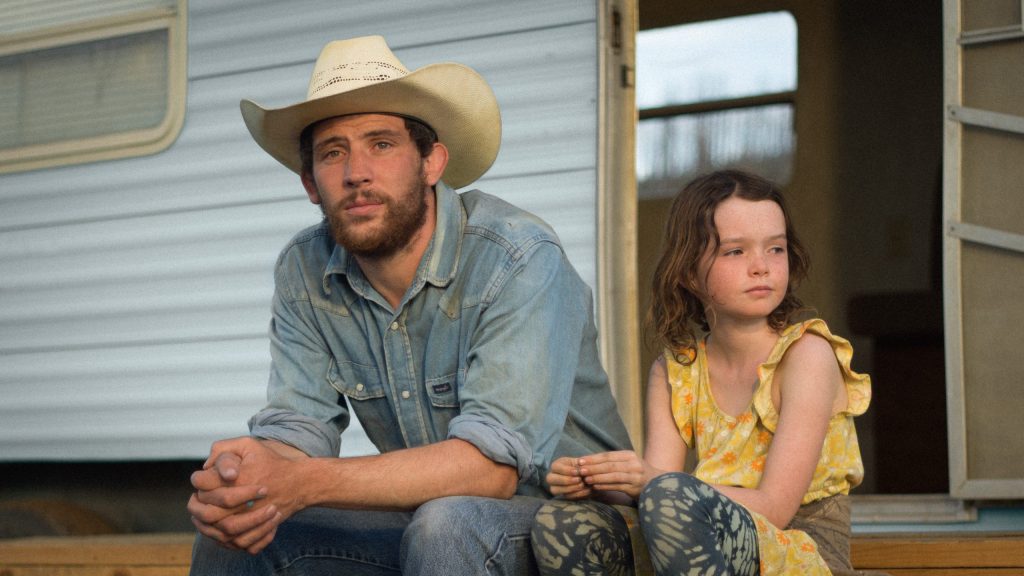
It is within this context that we are introduced to the story of Rebuilding. The film follows Dusty (Josh O’Connor), a cowboy from rural Colorado who has just moved to a trailer camp, sharing space with people who were also forced out of their own homes because of the fires.
Timeless atmosphere
In the first few minutes, it is difficult to be certain about time and place with any precision. The lifestyle, the rhythm of the narrative, and even the figure of the protagonist seem to lead us toward a somewhat timeless atmosphere, an in-between place, where nature dictates the rules and we simply accept them without questions.
Little by little, small details begin to situate us. A comment about Wi-Fi, a gravestone with the date 2020… But nothing is explained directly. Rebuilding simply introduces these small details until the setting takes shape when we least expect it.
Those details also highlights the economic differences experienced by the characters, since limited access to technology directly influences the reintegration, or reconstruction, of those families affected by the fire.
Josh O’Connor
Josh O’Connor’s performance remains a somewhat ambiguous point. The actor, whom many viewers may recognize from Challengers (2024) or from the Knives Out (2025) franchise, plays Dusty as an extremely restrained character, always carrying a fragility that seems ready to implode at any moment.
The problem is that O’Connor seems to rely on the same repertoire as always. The facial expressions, the shy smile, the body posture, and even the tone of voice feel very familiar, as if he were playing variations of the same character in different films.
At times it becomes a little distracting, as the sense of repetition is difficult to ignore. On the other hand, within the universe of the film, this performance works better than it might in another context. The protagonist is an introspective and emotionally closed-off man, and the actor’s discreet presence fits naturally with this type of character.
A beautiful and cozy atmosphere
Visually, the film also approaches a type of drama that relies more on observation than on major events. There is a contemplative aesthetic that may recall films such as Aftersun (2022) or The Florida Project (2017), which use the camera to follow simple moments of everyday life, allowing the atmosphere to build its own narrative.
The personal relationships follow this same logic. Dusty shares very beautiful moments with his daughter and also with his ex-wife and former mother-in-law, a long relationship that began back in their school days and continues even after the divorce. There is an evident affection between them despite all the changes that have happened over time.
And what truly gives the film its strength is the way it portrays the trailer camp. The place could easily be presented as a symbol of defeat or precariousness, but it instead becomes a home in reconstruction. Among the residents, moments of companionship emerge, along with small scenes of shared lightness between people who have gone through the same tragedy.
Small joys
Even with the fire, the loss of the land, and the passing of loved ones, the film still finds space for small joys. At several moments, we are taken by an unexpected sense of comfort, as if we were slowly being absorbed into that simple routine and by those families that gradually became one.
Throughout the entire screening of Rebuilding, I could not stop thinking about another film: Train Dreams (2026), which is currently in the race for the 2026 Oscars in three categories. But while that drama follows a protagonist devastated by loss and constant suffering, the story here moves in the opposite direction. The tragedy is there, of course, but it does not completely dominate the experience.
In the end, the film finds its strength in something much simpler than all of that. It is not exactly a story about fires or irreparable losses, but about what remains once the flames finally die down. Or, more importantly, about how even among ashes it is still possible to rebuild a home.
Rebuilding is available on Apple TV and Prime Video, with limited theatrical screenings. Watch the trailer below:



 On the Director’s Call
Leave a comment