

What are you thinking? This question lingers throughout the life of Parthenope (Celeste Dalla Porta), protagonist who shares the same name as Paolo Sorrentino‘s latest film, a name that also embodies the many questions raised by those around her.
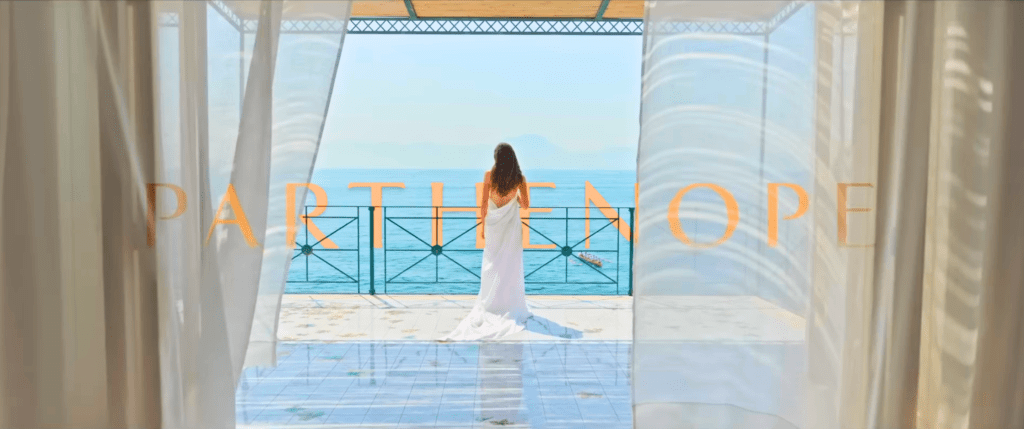
Anchored in the Greek myths that recount the birth of Naples, the feature takes us on an hypnotic sensory journey. At one point, it feels as if we could dive right into the screen — smelling the sea, feeling the sun on our skin, hearing the waves lull us to rest. The opening minutes of the film are just like this. Frames that look like paintings, orchestral sounds, the deliberate enchantment of the sirens luring travelers ashore.
Little by little, we are taken back to reality and to some reflections on the concept of beauty. “Are you aware of the disruption your beauty causes?”, one of the characters inquires the protagonist, who already suspected it. That question then brings me to mind other stories: Dorian Gray, Narcissus, and even Eve, considered the first woman in the biblical world.
At the end of the day, the message is clear: What are you thinking? Go back to your cocoon. In other words, that’s the society warning about the dangers of beauty and the awareness of those who see themselves as beautiful. And since beauty has been often associated with women for the most part, repression is also directed towards us.
It’s interesting how the city of Naples is personified by a woman named after the very siren from the myths. I had to do some research before writing this review, and came across the fact that Sorrentino chose to blend elements from different versions of the myth, discarding modesty and commitment to the truth. And in fact, watching Parthenope is like listening to a bed time story; It has that tone of adventure and fantastic realism, which we just accept, without trying to understand much.
But despite this, I couldn’t help but feel that this film was made for a specific audience, with little concern for explaining or contextualizing the world built through reinterpretations and ancient metaphors. It seems to assume that viewers come equipped with a deep well of references — without which, some moments might feel jarring.
From the very beginning, I noticed subtle indications that someone was going to die, just like typical Greek tragedy. But did everyone notice? And, even if they did, would they still be willing — or prepared — to witness the enchantment, which also hides eroticism, of Parthenope’s various family members, for whom they should only feel love?
And here I reflect, thinking about the hundreds of other Greek and Roman stories, portraits of a society from a specific era, but which no longer make sense in a work whose fictional time frame is the 20th century. And although Parthenope crafts a parallel dimension — where time and space feel fluid — it ultimately disrupts this illusion by marking each phase of the protagonist’s life with specific years, from her birth in 1950 to her retirement in 2023.
A simple solution, and I don’t understand why it wasn’t used, would be to replace the year markings with age markings. That way, the mysterious atmosphere would be maintained and our modern eyes could watch it with less judgment. We would stop trying to fit that filmic dimension into the social rules we live in today. After all, we are in 2025, dealing with a delicate historical moment, and certain themes could be better worked out to avoid distorted or mistaken interpretations.
At one point, I found similarities with The Dreamers (dir. Bertolucci, 2003), which also tackles problematic issues, but surprisingly, here, in Parthenope, the approach is a little more convincing. Especially for those who have the reference base to which I refer.
Early on, we meet a trio of friends whose relationships are ambiguous — are they siblings, lovers, or something in between? The film slowly untangles these connections, revealing tensions that echo ancient myths and societal taboos. Only in the second part it is confirmed that Sandrino (Dario Aita), Parthenope’s first love interest, is the son of the housekeeper. Despite this, there is a certain suggestion that Raimondo (Daniele Rienzo), who is really her brother, has forbidden desires, which, thank God, were not fulfilled at any time. There is also a joke between Parthenope and the Comandante, her godfather (Alfonso Santagata), which is referenced to more than once. It’s when he asks her: “If I were younger, would you marry me?” and she answers back “And would you still want me if I were younger?”
Honestly, I believe that this sentence, as well as the others mentioned here in this review, reflects the challenges that Parthenope — who represents not only the city of Naples and the mythical mermaid, but also the female archetype — faces simply because she was born a woman and is experiencing her youth.
When researching what people were saying about Parthenope on Letterboxd, I found a comment that made me laugh. They said it looked like a long perfume commercial, which actually makes sense, since Saint Laurent is responsible for producing the film, in which the main theme is beauty, in the purest sense of the word.
Based on this, and all the questions raised throughout the narrative, I ask myself: if we stripped away all the cinematic beauty, if we took away the saturated colors, the paradisiacal scenery, the sound of the waves, the painting-like shots, the meticulously arranged costumes… If we took all of this away, would we still have such a good film?
Parthenope officially premieres on March 20, 2025. Check out the trailer below:



 On the Director’s Call
Leave a comment